
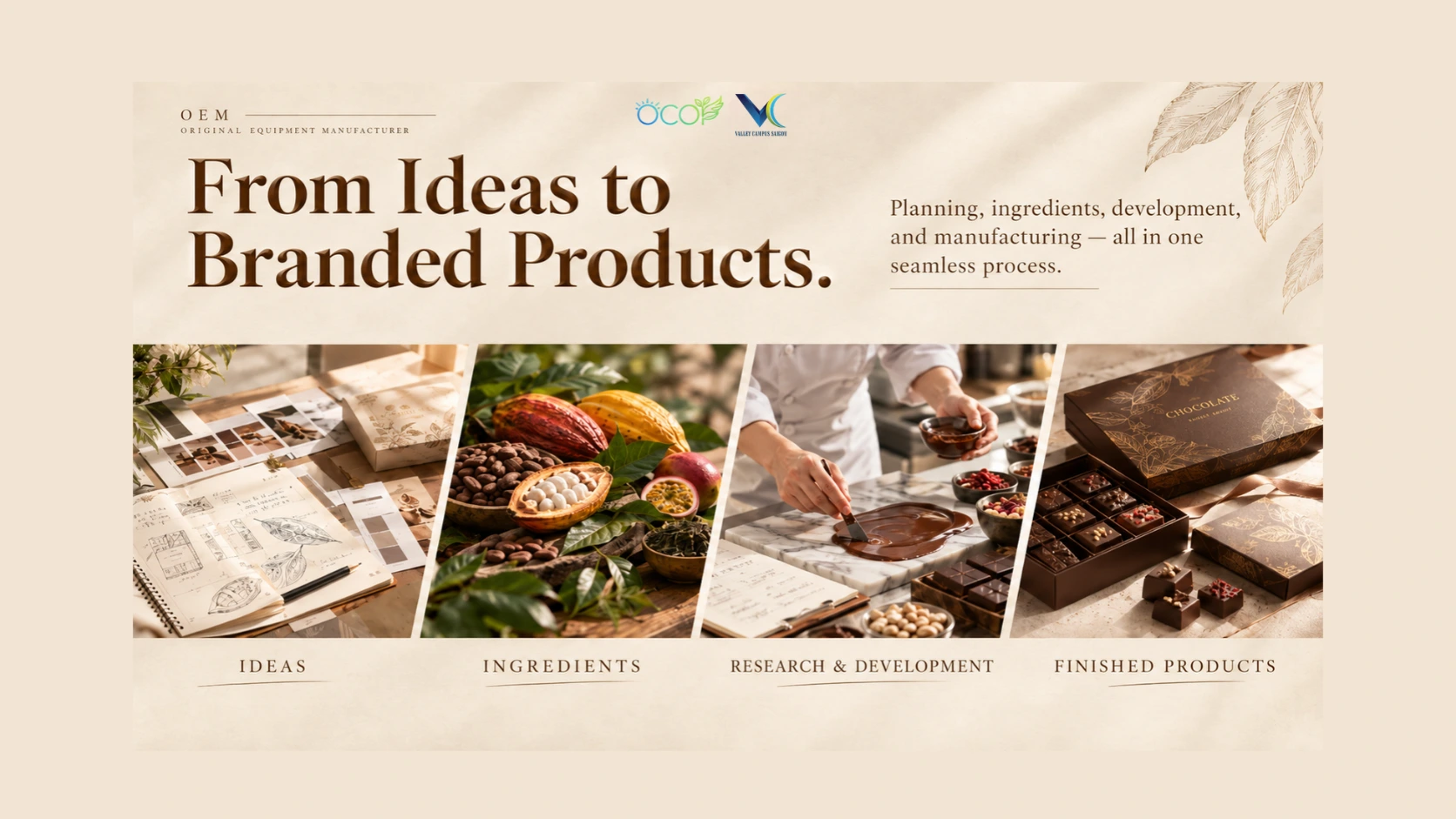
Nowadays, more and more businesses want to own products that carry their unique brand identity.
It could be a line of chocolates designed for corporate gifts.
A product that combines cocoa with local ingredients.
Or a completely new flavor developed for a specific group of customers.
However, not every business has its own factory, R&D team, or production system.
That is why the OEM (Original Equipment Manufacturer) model is increasingly being chosen by many businesses.
What is OEM?
In simple terms, OEM is a form of collaboration where a business with a product idea works with a manufacturing unit to turn that idea into a tangible product.
Instead of having to invest in the entire production line, factory, or research team, the business can focus on branding, business strategy, and target market.
Meanwhile, the OEM unit will support specialized processes such as:
- Research and product development
- Consultation on suitable ingredients
- Flavor profile design
- Recipe testing
- Production and quality control
- Finalizing the product before market launch
For the chocolate industry, OEM is not just about processing according to existing formulas. Many businesses today want to create products that have their own identity, linked to their brand story and market positioning.
Every product starts with an idea
Before a complete chocolate bar is created, the first thing that often appears is not the recipe.
But an idea.
There are businesses that want to create a line of chocolate with tropical flavors from Vietnam.
There are brands that want to develop premium gift products for the Japanese market.
Some entities wish to combine cacao with tea, fruits, or local specialty ingredients.
At this stage, the most important question is often:
"Who is this product for and what story does it tell?"
Once the goal is clear, the process of developing a new product truly begins.
Search for suitable materials
In the chocolate industry, the quality of raw materials has a significant impact on the quality of the final product.
According to VCS's OEM ecosystem, Vietnamese cacao from regions like Binh Phuoc and Cat Tien possesses unique flavor characteristics such as tropical fruits, floral notes, honey, or roasted nuts, providing a foundation for various product directions.
Therefore, the selection of raw materials is not only based on quality standards.
It must also align with the story that the brand wants to build.
A product aimed at elegance will differ from one that embodies a youthful and creative spirit.
Flavor profile design
After identifying the ingredients, the next step is to create the flavor profile.
This stage helps transform initial ideas into a tangible experience that consumers can perceive.
According to VCS's OEM model, businesses can receive advice on selecting ingredients, customizing the flavor profile, and developing products that align with their brand direction.
For example:
- Tropical fruit flavor for the young customer segment
- Elegant flavor combining tea and lotus seeds for the premium gift segment
- Rich flavor for those who love original chocolate
Each choice contributes to the uniqueness of the final product.
Testing and refining the product
Not every idea becomes a product on the first try.
In fact, many products go through multiple rounds of evaluation and adjustment before achieving the desired flavor.
- Ingredient ratio.
- Sweetness.
- Texture.
- Aroma.
- Tasting experience.
Everything needs to be continuously tested and refined.
This is also the stage that helps businesses assess whether the product truly meets the needs of the target customers.
From raw materials to commercial products
When the formula is finalized, the product will enter the production phase.
In the OEM ecosystem, VCS combines supply chain management, quality control, and traceability to ensure stability between production batches.
This is especially important for businesses that want to build a long-lasting brand.
Because customers always expect the same quality every time they choose a product.
OEM is not just manufacturing
Many people think OEM simply means "order and manufacture."
But in reality, modern OEM is a process that accompanies from the idea to the finished product.
- That is market research.
- Finding suitable ingredients.
- Building a flavor profile.
- Developing a formula.
- Quality control.
And finally, to create a product that carries the brand's unique signature.
Ultimately, what makes a product valuable is not just how it is made.
It also lies in the story, identity, and experience it brings to the consumer.
🌱 OCOP GIFT – All supplies, one platform
#OCOPGIFT #ChocolateOEM #ProductDevelopment #Gifts #PremiumGifts
📌 Contact Information & Connections:
- Website: https://ocop.online
📱 Follow OCOP GIFT on social media:
Line: updating
TikTok: updating
Youtube: https://www.youtube.com/channel/UCihLVEU9hDh_Ut67l0U7bSw
Instagram: https://www.instagram.com/ocop.contact.vcs/
X (Twitter): https://x.com/ocopcontactvcs
Facebook: https://www.facebook.com/profile.php?id=61590947802312
Email: marketing@vcs-ai.com
Hotline (Japanese - Vietnamese support): +84 915 878 333
Japan Office: 神奈川県藤沢市藤沢388富士ビル 5F
Vietnam Office: 76A/3, Tran Huu Trang Street, Phu Nhuan, Ho Chi Minh City.