
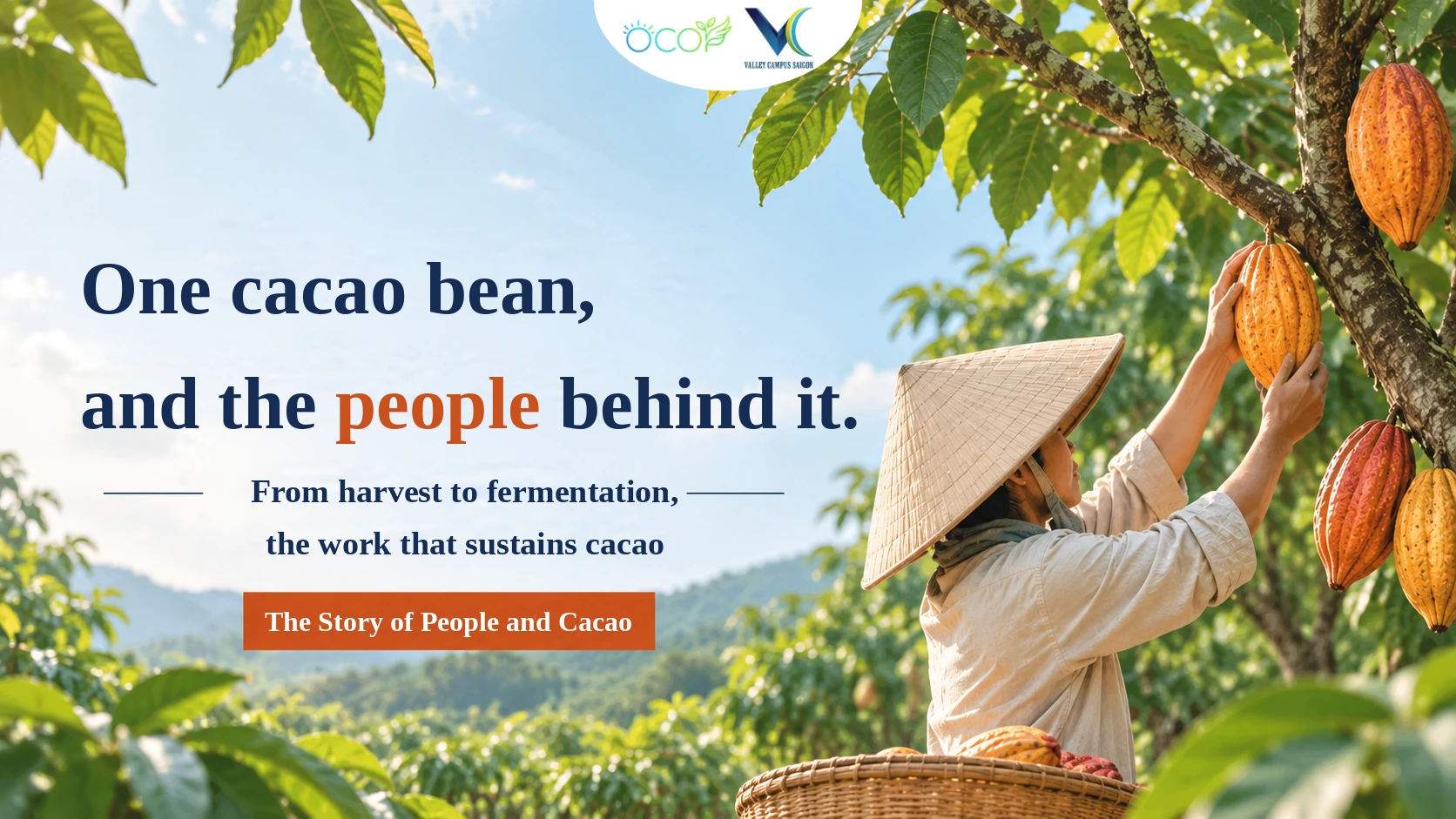
Some products are often judged by consumers based on their flavor, quality, or appearance. Yet behind these qualities lies an entire journey shaped by the contributions of many people.
Cacao is no exception. Before becoming an ingredient in chocolate bars, cacao beans go through multiple stages, from growing and harvesting the pods to extracting the beans, fermenting, and drying them. Each stage involves people who contribute their experience and care to the work they do.
In Japan, November 23 is celebrated annually as Kinrō Kansha no Hi (勤労感謝の日) – Labor Thanksgiving Day, an occasion to recognize contributions to labor and production while expressing appreciation for everyone's hard work.
On this occasion, let's look back at the journey of a cacao bean through the work and people behind every harvest season.
1. Farmers – Laying the Foundation for Every Cacao Harvest
The journey of cacao begins in the plantations, where farmers dedicate their time to caring for the trees and monitoring their growth throughout the seasons.
From observing tree conditions and caring for the soil to monitoring pod development, every task requires patience and an understanding of growing conditions. Farmers also need to pay attention to pod ripeness to determine the appropriate harvesting time.
These activities may not be visible in the final product, but they are an important part of the quality of the incoming raw material. A cacao harvest is not simply the result of natural conditions; it is also closely connected to the cultivation process and the experience accumulated by growers.
2. Harvesting and Bean Extraction – Care from the Very First Steps
When cacao pods reach the appropriate level of ripeness, workers harvest them and then split them open to extract the beans surrounded by their mucilage pulp.
This stage requires care in every step. Selecting the pods, harvesting at the right time, and handling the beans after extraction all play a role in the subsequent processing stages.
Once removed from the pods, cacao beans cannot immediately become an ingredient for chocolate. They need to undergo further post-harvest processing, with fermentation being one of the stages that significantly influences flavor development.
3. Fermentation and Drying – Where Experience Meets Technique
After harvesting, cacao beans together with their surrounding pulp are placed into the fermentation process. During this stage, microbial activity and biochemical changes contribute to the formation of precursors needed for chocolate flavor development in subsequent processing stages.
To ensure the process proceeds appropriately, workers need to monitor several factors, including time, temperature, turning practices, and the progression of each fermentation batch. Practical experience helps them recognize the condition of the raw material, while data recording provides a basis for monitoring and evaluating the process.
Once fermentation is complete, cacao beans are dried to reduce their moisture content to an appropriate level for storage and transportation. This stage also requires attention to drying conditions and bean condition to minimize unwanted effects on quality.
Behind these technical parameters is the continuous work of monitoring and handling carried out by workers. The combination of experience and process control methods helps establish a clearer basis for evaluating each batch of raw materials.
4. From Cacao Beans to Chocolate – The Journey Continues
After the preliminary processing stages are completed, cacao beans undergo further inspection, transportation, and delivery to processing facilities.
At this point, the work of people throughout the supply chain continues. Quality control personnel assess bean conditions; procurement teams explore raw material sources; and production teams carry out roasting, grinding, and chocolate formulation.
Each stage has its own requirements. For example, manufacturers need to consider physical characteristics, moisture content, defective bean ratios, and post-roasting flavor when assessing the potential applications of raw materials.
Therefore, the story of cacao does not end where the beans are grown or how they are harvested. Information about processing methods, batch-specific characteristics, and evaluation results also helps manufacturers better understand the raw materials they use.
5. Understanding the Raw Material Journey to Appreciate the Value Behind Every Cacao Bean
Looking at the entire supply chain, it becomes clear that the value of a cacao bean is not created by a single stage or individual. It is the result of connections between growers, harvesters, post-harvest processing workers, suppliers, and manufacturers.
For the B2B cacao industry, understanding this journey also has practical value when selecting raw material sources. Information about growing regions, harvesting conditions, fermentation methods, drying, and batch evaluation results provides manufacturers with additional grounds for exploring and comparing supply sources.
For cacao sourced from Cát Tiên and Châu Đức, VCSxOCOPGIFT aims to connect origin information with the characteristics and processing journey of each raw material sample. This allows business customers to gain a clearer understanding of Vietnamese cacao, not only through where the beans are harvested but also through the stages that shape their characteristics.
Labor Thanksgiving Day – Appreciating the Contributions Behind Every Product
November 23 is an occasion to pay attention to the work and contributions that are sometimes difficult to see in the finished product.
In the cacao industry, this may include farmers who spend months caring for their plantations, workers who carefully harvest each pod, or those who directly monitor every fermentation and drying batch.
Each person takes on a different responsibility, but all contribute to moving the raw material further along its journey toward becoming a finished product.
On Japan's Labor Thanksgiving Day, VCSxOCOPGIFT would like to express its appreciation to everyone contributing to the agricultural industry and the cacao supply chain.
Because behind every cacao bean lies not only a story of origin or flavor, but also the hard work of many people who come together to create its value.
🌱 OCOP GIFT – All supplies, one platform
#VCSxOCOPGIFT #KinroKanshaNoHi #VietnameseCacao #CacaoSupplyChain #HonoringWorkers
📌 Contact Information & Connections:
- Website: https://ocop.online
📱 Follow OCOP GIFT on social media:
Line: updating
TikTok: updating
Youtube: https://www.youtube.com/channel/UCihLVEU9hDh_Ut67l0U7bSw
Instagram: https://www.instagram.com/ocop.contact.vcs/
X (Twitter): https://x.com/ocopcontactvcs
Facebook: https://www.facebook.com/profile.php?id=61590947802312
Email: marketing@vcs-ai.com
Hotline (Japanese - Vietnamese support): +84 915 878 333
Japan Office: 神奈川県藤沢市藤沢388富士ビル 5F
Vietnam Office: 76A/3, Tran Huu Trang Street, Phu Nhuan, Ho Chi Minh City.