
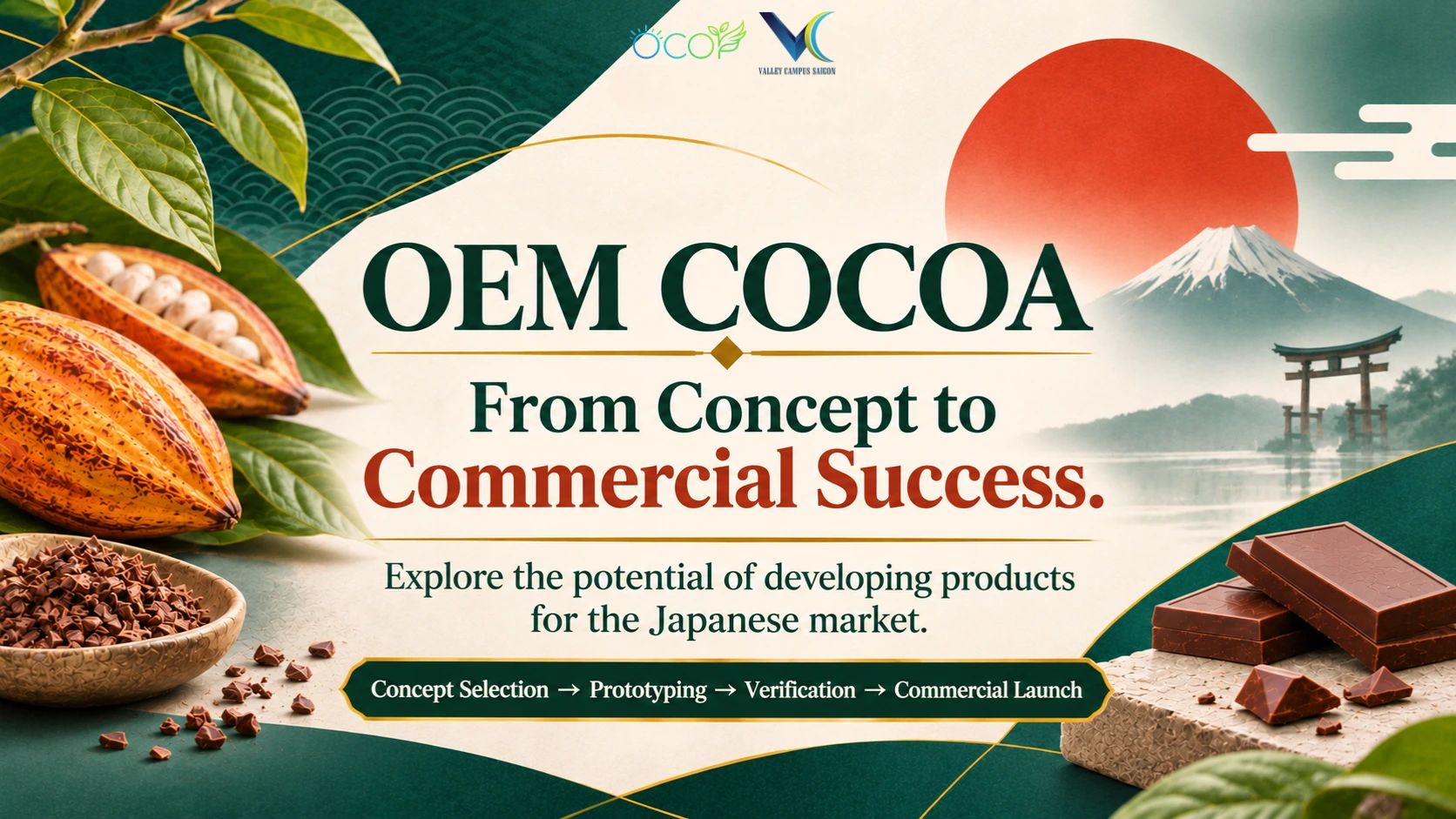
An appealing chocolate idea can be the starting point for a new product. However, when bringing that idea into reality, businesses need to consider more than just flavor or the appearance of the finished product: Are the ingredients suitable? What testing does the product require? And can the concept meet buyer needs?
For B2B cacao in Japan, OEM can open up additional ways to apply cacao beyond supplying cacao beans. However, not every idea needs to be implemented at the same time. A concept with potential does not necessarily mean its commercial viability has already been established.
Therefore, rather than developing multiple products from the outset, selecting a number of well-founded concepts for testing can make the development process more focused — from buyer needs and raw material characteristics to the conditions that need to be verified before scaling up.
OEM as a Complementary Development Direction for Cacao Supply
In the B2B cacao strategy, cacao beans remain the core product for building supply relationships and validating buyer demand. OEM offers a complementary direction: incorporating cacao into specific applications, from production ingredients to chocolate products with distinct positioning.
However, OEM development also needs to be considered alongside raw material supply capability. If cacao beans are allocated for processing without a plan to replenish the supply, allocating raw materials to OEM may affect the objective of supplying cacao beans.
Therefore, concept selection is not simply about finding an interesting idea. Businesses need to consider whether the concept is suitable for target buyers, can be validated through sample testing, and can be developed without creating an imbalance in raw material supply.
Four OEM Concepts Selected for Evaluation
Rather than expanding the product portfolio immediately, focusing on a selected group of concepts helps give each trial a clearer objective. For cacao and chocolate, each development direction has its own target customers, applications, and evaluation requirements.
1. Cacao Nibs – An Ingredient for B2B Customers
Cacao nibs are being considered as an ingredient for businesses looking to incorporate cacao into their own products.
For this concept, the key consideration is not only the form of the ingredient, but also its suitability for the buyer's specific application. A pilot phase can help evaluate how the nibs are used, gather feedback, and identify areas for adjustment before considering the potential for expansion.
This development direction should begin with the partner's actual usage requirements, rather than simply introducing the ingredient as a new product.
2. Bean Glacé – A Development Direction for the Gourmet Segment
Bean glacé offers a different approach from supplying cacao beans as an ingredient. This concept targets the gourmet product segment, where the finished product experience and quality throughout storage also need to be considered.
One of the factors requiring verification is shelf life – the period of time a product can be used and its ability to maintain quality under appropriate storage conditions.
Before considering commercial development, testing is needed to evaluate the product over its intended period of use. A sample that creates a positive first impression is not enough to determine whether the product can maintain its quality throughout its shelf life.
3. Orange × Chocolate – Combining Chocolate and Orange
The combination of orange and chocolate can be considered for gift-oriented products, with the flavor experience coming from the pairing of the two ingredients.
However, in addition to flavor evaluation, this concept also needs to consider conditions related to temperature and packaging. These factors may affect product quality during storage and transportation.
Therefore, testing should go beyond the question “Does the product taste good?” and also examine whether the product can maintain an appropriate condition under the anticipated circumstances.
4. Mango × Chocolate – Combining Chocolate and Mango
For mango × chocolate, the development direction is also being considered within the gift product category. However, to understand its feasibility, both the product characteristics and the raw material structure need to be clarified.
Two areas requiring attention are shelf life and BOM (Bill of Materials) – the list of materials and components that make up a product.
Shelf life helps identify aspects that need to be verified regarding the product's expiration period and its ability to maintain quality. Meanwhile, the BOM clarifies the components required for product development, thereby supporting cost structure evaluation.
These are essential foundations before assessing whether the concept is suitable for further development.
What Should a Sample Test Help Businesses Verify?
A sample test is valuable not only because it creates a new experience, but also because it helps answer a specific question about the product.
For the four concepts above, the evaluation focus will differ:
- Cacao nibs: Are they suitable for B2B ingredient applications and buyer requirements?
- Bean glacé: Can the product maintain its quality throughout the intended shelf life?
- Orange × chocolate: Do the flavor, temperature, and packaging meet the intended gift product positioning?
- Mango × chocolate: Are the shelf life and raw material structure suitable for the development direction?
By clearly defining what needs to be verified, each trial can provide more useful information for the next decision. Businesses can prioritize concepts that align with target buyers and current implementation capabilities, rather than developing multiple samples simultaneously without a clear basis for evaluation.
From Concept to Commercial Development Decisions
In B2B OEM, positive feedback on a sample is an encouraging signal, but it is not enough to confirm commercial viability.
A product still needs to be evaluated across multiple aspects: technical requirements, costs, production volume, supply conditions, and suitability for sales channels. For the Japanese market, engaging with relevant buyers and gathering actual feedback is also an important part of the evaluation process.
Samples, technical information, and verification results help businesses determine which concepts have a basis for further development, which require adjustments, and which need additional data.
This also helps avoid expanding the product portfolio based solely on ideas while the necessary conditions for commercial development remain unclear.
Focused OEM Development to Create Long-Term Value
Cacao OEM is not simply about creating another product from cacao ingredients. It is a process of selecting suitable concepts, identifying the factors that need to be verified, and connecting development outcomes with actual buyer needs.
With its focus on Japan, VCS evaluates OEM concepts step by step while maintaining its priority on cacao bean supply. From cacao nibs and bean glacé to ideas combining chocolate with orange or mango, each development direction needs to be assessed based on its own product characteristics and commercial requirements.
Because a concept with potential is not necessarily the one that can be implemented the fastest. It may be the concept for which a business clearly understands what needs to be verified, has a sound basis for further development, and aligns with market demand.
From idea to commercial product, what matters is not only creating an appealing concept, but also finding a development direction that can be validated and meet actual market needs.
🌱 OCOP GIFT – All supplies, one platform
#VCSxOCOPGIFT #CacaoB2B #ChocolateOEM #JapaneseCacaoMarket #PremiumGifts
📌 Contact Information & Connections:
- Website: https://ocop.online
📱 Follow OCOP GIFT on social media:
Line: updating
TikTok: updating
Youtube: https://www.youtube.com/channel/UCihLVEU9hDh_Ut67l0U7bSw
Instagram: https://www.instagram.com/ocop.contact.vcs/
X (Twitter): https://x.com/ocopcontactvcs
Facebook: https://www.facebook.com/profile.php?id=61590947802312
Email: marketing@vcs-ai.com
Hotline (Japanese - Vietnamese support): +84 915 878 333
Japan Office: 神奈川県藤沢市藤沢388富士ビル 5F
Vietnam Office: 76A/3, Tran Huu Trang Street, Phu Nhuan, Ho Chi Minh City.