
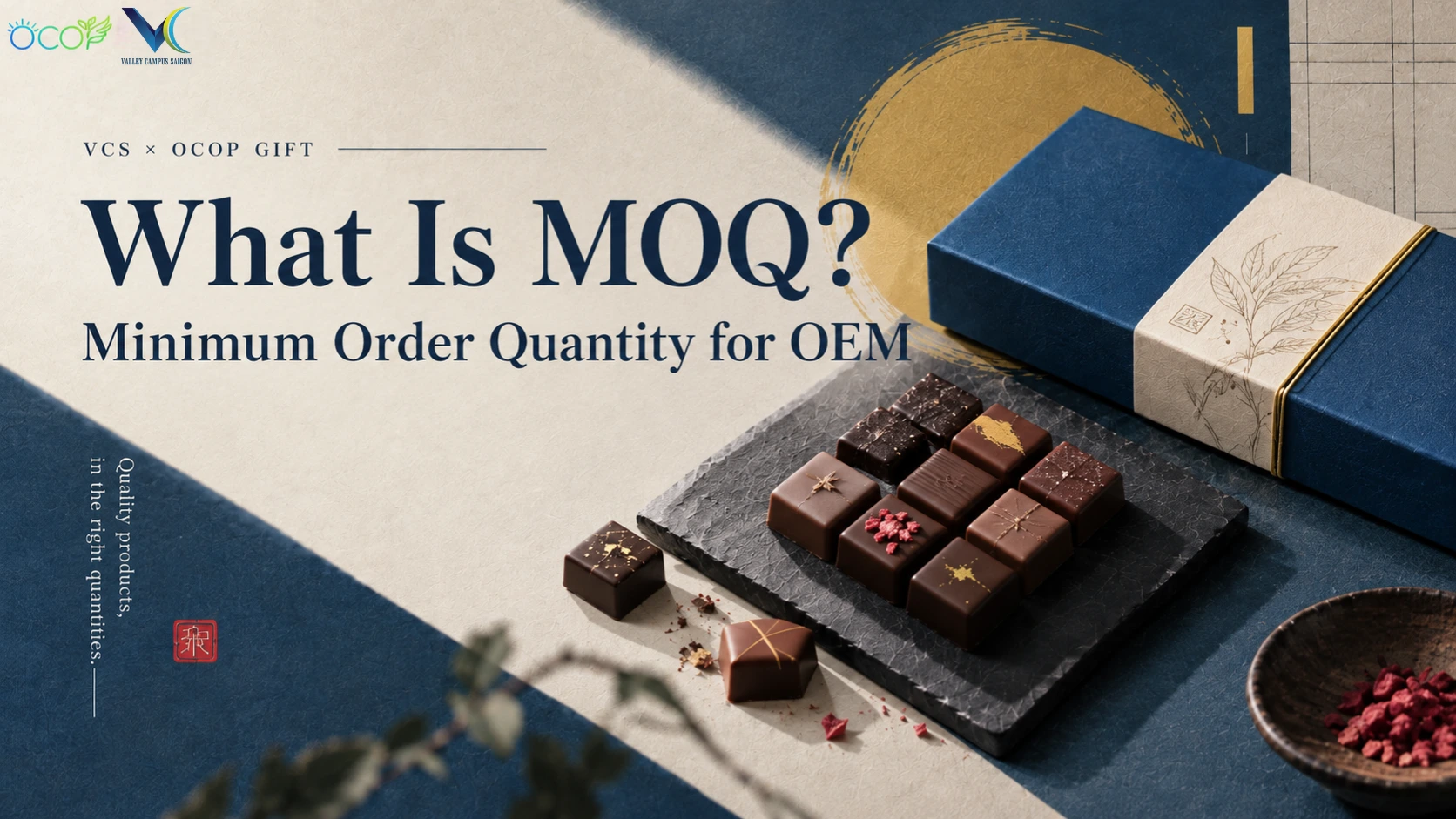
What is MOQ? Why is MOQ important in OEM products? | VCS x OCOP GIFT
When starting to develop an OEM product, businesses are often concerned with ingredients, formulas, flavors, and how to bring the product to market. But alongside those factors, there is a question that needs to be clarified from the very beginning: What is the minimum order quantity?
This is when MOQ – Minimum Order Quantity – becomes an important factor in the product development process.
So how is MOQ determined, and why can two products that are both chocolate have different MOQ levels for each OEM project?
What is MOQ?
MOQ is the minimum quantity of products that a manufacturer requires in a single order or production run. This level may depend on ingredients, formula, processing method, finished product specifications, and actual production conditions.
For example, a business that wants to develop its own branded chocolate will need to discuss the minimum quantity of products for each production run. However, this number is not necessarily the same as for another chocolate product, because each product may come with its own requirements.
Therefore, MOQ is not simply an order limit number. It is also the basis for businesses and manufacturers to find an implementation scale that suits the product characteristics and business plan.
Why does MOQ differ between OEM products?
In OEM, each product is developed based on its own set of requirements. Some factors commonly considered when determining MOQ include:
- Ingredients and supply capacity
For chocolate products combined with Vietnamese fruit, businesses may choose mango, strawberry, or other fruits. Each ingredient has its own characteristics in terms of flavor, texture, moisture, and processing method.
If ingredients need to be prepared at a certain scale or have specific pre-processing requirements, the production quantity may need to be adjusted to suit actual conditions. Supply sources and seasonality are also factors to consider when planning.
- Formula and processing method
Although they are all chocolate, the way each product is made can be very different.
Fruit-coated chocolate and chocolate with fruit components blended inside may require different processing steps. Differences in formula, texture, and processing method can affect how production is organized.
That is why two products in the same chocolate category can still have different MOQs.
- Packaging and finished product specifications
A product using standard packaging may have a different implementation approach from a product requiring a custom box, logo printing, or design based on brand identity.
For corporate gift chocolate, for example, gift boxes, message cards, and product arrangement also need to be taken into account. These requirements can affect the amount of packaging to be prepared and the production plan.
- Production conditions
Each manufacturing unit has different equipment capacity and operating methods. Some stages may be carried out in batches or according to the amount of prepared ingredients.
Therefore, MOQ needs to be considered based on actual production conditions, rather than assuming that the quantity level of one product can be applied to all OEM projects.
How does MOQ affect business planning?
MOQ is not only relevant to the manufacturer side but also affects how businesses prepare budgets and distribution plans.
When producing in larger quantities, some preparation costs can be allocated across more product units, thereby helping reduce the cost per product. However, larger quantities also mean a higher total order budget and may create additional inventory pressure.
Especially for new products, businesses need to balance production scale, market demand, and sales capacity. An appropriate MOQ level lies not only in the cost per product but also in the ability to balance budget and business plan.
MOQ in a chocolate OEM project
Let's imagine two product development ideas:
- Fruit-coated chocolate: The business wants to combine chocolate with dried mango or strawberry. Factors to discuss may include ingredient sources, fruit processing methods, chocolate formula, and packaging specifications.
- Private-label gift chocolate: In addition to formula and product quantity, the business needs to consider requirements for gift boxes, design, logo, and presentation.
Both products are chocolate, but the accompanying requirements may differ. Therefore, MOQ needs to be determined based on the entire product plan, rather than only on the name or product category.
MOQ in the OEM product development process
MOQ is usually discussed during the product development process and may be further clarified as requirements for formula, ingredients, and finished product specifications gradually become finalized.
At VCS x OCOP GIFT, the OEM product development journey is oriented through the following stages:
- Concept: Define the idea, product goals, and business needs.
- Product Development: Research ingredients, formula, and finished product direction.
- Testing & Refinement: Test, evaluate, and adjust the product.
- From Prototype to Production: Finalize standards, specifications, and assess production feasibility.
MOQ – Part of the product development strategy
A good OEM idea needs to go together with an appropriate implementation plan. From ingredients and formula to specifications and budget, each factor contributes to shaping the final product.
MOQ helps connect those requirements with the actual production scale. Clear discussion about the minimum order quantity from the beginning will help businesses be more proactive in the process of research, testing, and planning to bring the product to market.
With VCS x OCOP GIFT, the product development journey begins with clearly understanding the partner's ideas and needs, then discussing together to find a suitable plan for each OEM project.
🌱 OCOP GIFT – All supplies, one platform
#OCOPGIFT #VCS #MOQ #OEMChocolate #Manufacturing
📌 Contact Information & Connections:
- Website: https://ocop.online
📱 Follow OCOP GIFT on social media:
Line: updating
TikTok: updating
Youtube: https://www.youtube.com/channel/UCihLVEU9hDh_Ut67l0U7bSw
Instagram: https://www.instagram.com/ocop.contact.vcs/
X (Twitter): https://x.com/ocopcontactvcs
Facebook: https://www.facebook.com/profile.php?id=61590947802312
Email: marketing@vcs-ai.com
Hotline (Japanese - Vietnamese support): +84 915 878 333
Japan Office: 神奈川県藤沢市藤沢388富士ビル 5F
Vietnam Office: 76A/3, Tran Huu Trang Street, Phu Nhuan, Ho Chi Minh City.